Jack realizes he loves Trixie
It Must Be Love: A Mustang Prairie RomanceJack realizes he loves Trixie at the opening of his art exhibition, in a moment that transforms his understanding of both his paintings and his relationship with her. Until then, he has classified their connection as pleasurable, simple, and temporary, partly because his disastrous marriage to Marissa has made him distrust love itself. Looking at the painting of Trixie, however, he recognizes that his newest body of work has been shaped by her presence: the vivid colors, including the recurring image of her rainbow hair, reveal an emotional investment he had refused to name. The realization is both a romantic discovery and a belated reckoning with the damage caused by his refusal to acknowledge it sooner.
Conditions Before the Recognition
Jack’s resistance to love grows out of the history of his marriage to Marissa. His mother tells him that Trixie had once remained near him while carefully avoiding the happiness he shared with Marissa, and that the tension, anger, and resentment surrounding the marriage had been impossible to conceal. She urges him to tell Trixie the truth because competing with the memory of a dead woman is an unfair burden. Jack answers that he cannot repeat marriage, treating his earlier experience as proof that intimacy leads toward the same failure. His reluctance therefore protects him from renewed pain, but it also keeps him from distinguishing the old marriage from the new relationship developing with Trixie.
His behavior toward Trixie repeatedly exposes the limits of that self-protection. He tells himself that their intimacy is uncomplicated even while jealousy appears when Ty openly flirts with her. At a gathering, Jack watches Trixie steady herself on Ty’s shoulder and reacts with a flare of possessiveness before turning the feeling into teasing. On their dinner date, Trixie arrives in a white tank top, red bra, black leather pants, knee-high boots, and a black leather jacket, while Jack appears in a cream sweater and black pants. The deliberately charged clothing and their nervous anticipation make the supposed boundary between casual sex and emotional attachment increasingly unstable. They have already had sex, fought, and agreed not to repeat it, yet Jack is still taking her to dinner and Trixie is treating the evening as a date while trying to call it something less consequential.
The Artistic Discovery
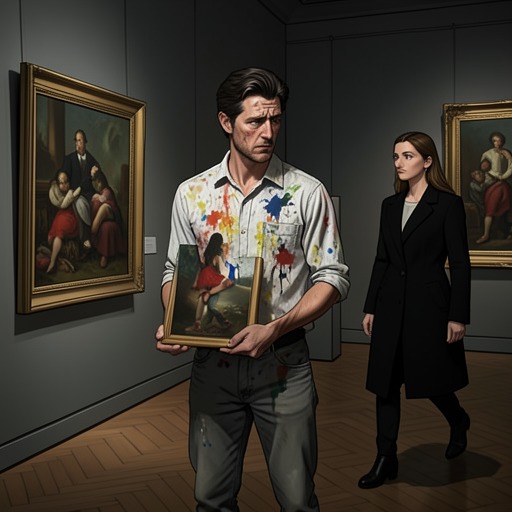
The decisive evidence comes through Jack’s work rather than through a direct conversation. His parents stop at one of the paintings on the gallery wall, and his mother becomes tearful at the image. Jack knows that the work is a painting of Trixie, and he had wanted his mother to see it before it was sold. His immediate self-judgment is that he has behaved like an idiot: he has wanted Trixie but has not shown her the painting or explained what it means. The artwork makes his divided position visible. He has treated Trixie as a temporary pleasure while producing an entire series whose emotional center is her.
Jack first tries to preserve the distinction between his love for Marissa and what he feels for Trixie. His marriage had involved an overwhelming, almost obsessive passion that later settled into familiarity before turning sour, and he assumes that the absence of that exact pattern means his feelings for Trixie cannot be love. He describes their connection internally as fun, easy, and uncomplicated, then tests that conclusion against the painting. The comparison fails. When he looks around the gallery, he sees Trixie’s colors everywhere, her rainbow hair recurring across the newest series. The work has recorded a devotion that his conscious mind has denied.
The recognition does not simply repeat Jack’s former experience; it changes his definition of love. His feeling for Trixie is unfamiliar because it does not initially resemble the consuming passion of his marriage, yet its difference does not make it less real. The painting allows him to perceive continuity between desire, attention, artistic creation, and emotional dependence. What he had called an easy arrangement has already reorganized his imagination. The supposedly casual relationship has entered the structure of his work, and the gallery becomes the place where his private denial is made public to himself.
From Private Insight to Public Confession
Jack later states the realization aloud when Sadie challenges his motives. She accuses him of having treated Trixie callously, disregarded her feelings, and used the old crush she had on him because he knew she would not refuse him. She also questions whether he wants Trixie back only because Trixie has stopped wanting him. Jack could respond defensively, but instead he forces himself to answer the question that has become unavoidable. He says that he realized at his opening that he loves her.
The confession is humiliating because it occurs in front of his friends and because it exposes how long he has misunderstood his own conduct. Jack is not ashamed of loving Trixie; he is ashamed that he required a crisis, an exhibition, and public pressure before admitting it. Sadie immediately treats the declaration as a call to action, urging him to go after Trixie while the others encourage him. His recognition therefore shifts the value of the situation from emotional denial to acknowledged love, but it does not yet secure Trixie’s return. Jack still has to face the consequences of having discovered the truth too late.
Family Memory and Emotional Legitimacy
The recognition is surrounded by objects and family scenes that connect Trixie to the Thorpe household rather than leaving her as an isolated romantic figure. Abby finds a photograph of her mother in the basement and asks Trixie to help make a hat like Marissa’s because Jack will not allow Abby to spend time at Trixie’s store. Trixie agrees to help, while carefully telling Abby to clear the plan with her father. When Trixie photographs Abby and Andie wearing the finished hat, she notices Marissa’s face in the original photograph and chooses the porch as the setting, linking a new memory to an older maternal image.
That continuity becomes important to Jack’s daughters. Abby tells Jack that Trixie makes them beautiful things, treats them like older children rather than babies, and gave Abby good memories of Marissa. Jack remembers how happy Abby was with the photograph and how she keeps it beside a similar picture of her mother. The girls’ acceptance does not create Jack’s love, but it confirms that Trixie has already become part of the family’s emotional life. Andie later tells Jack that he should apologize to Trixie and reveals that she and Abby know he likes her because he holds Trixie’s hand when he thinks no one is watching. Their observations turn a supposedly private affair into a relationship visible within the household.
Trixie’s Christmas gift to Jack also demonstrates the reciprocity that his late recognition has failed to protect. Jack gives Trixie the original of Blue Skies, her favorite painting, and she understands that receiving it will make it harder to get over him. The gift is tender, intimate, and painful because it arrives while she is trying to suppress her love. Jack’s paintings thus operate in both directions: his work reveals his love to himself, while his gift gives Trixie an object that intensifies feelings she is attempting to control.
Consequences and Narrative Significance
Jack’s realization is an anagnorisis produced by accumulated contradiction. He wants Trixie, envies the attention she receives from other men, paints her repeatedly, gives her a treasured original, and permits his daughters to form affectionate memories with her, yet he continues to describe the relationship as easy and noncommittal. The exhibition does not introduce a new feeling so much as make an existing feeling impossible to misread. Its decisive force lies in the collapse of the story Jack has been telling himself.
The recognition also exposes his central failure. Trixie has already begun avoiding him, arriving at Thanksgiving only ten minutes before the meal and claiming that she lost track of time. Jack understands that she has waited until the last possible moment to limit contact, even though he continues to hear about her through Jonquil and the girls. His love therefore emerges alongside her withdrawal, not before it. The emotional reversal is sharp: Jack moves from assuming that Trixie will remain available to realizing that his own belated honesty may no longer be enough.
When he leaves to find her after Sadie’s command, the street is empty. The scene refuses to turn recognition immediately into resolution. Jack has finally named the truth, but the person who needs to hear it is gone. That unfinished pursuit gives the event its narrative significance: love becomes real for Jack precisely when control over its outcome has been lost. His paintings have already preserved what he could not say, but the next step requires an apology and an encounter that the recognition itself cannot guarantee.